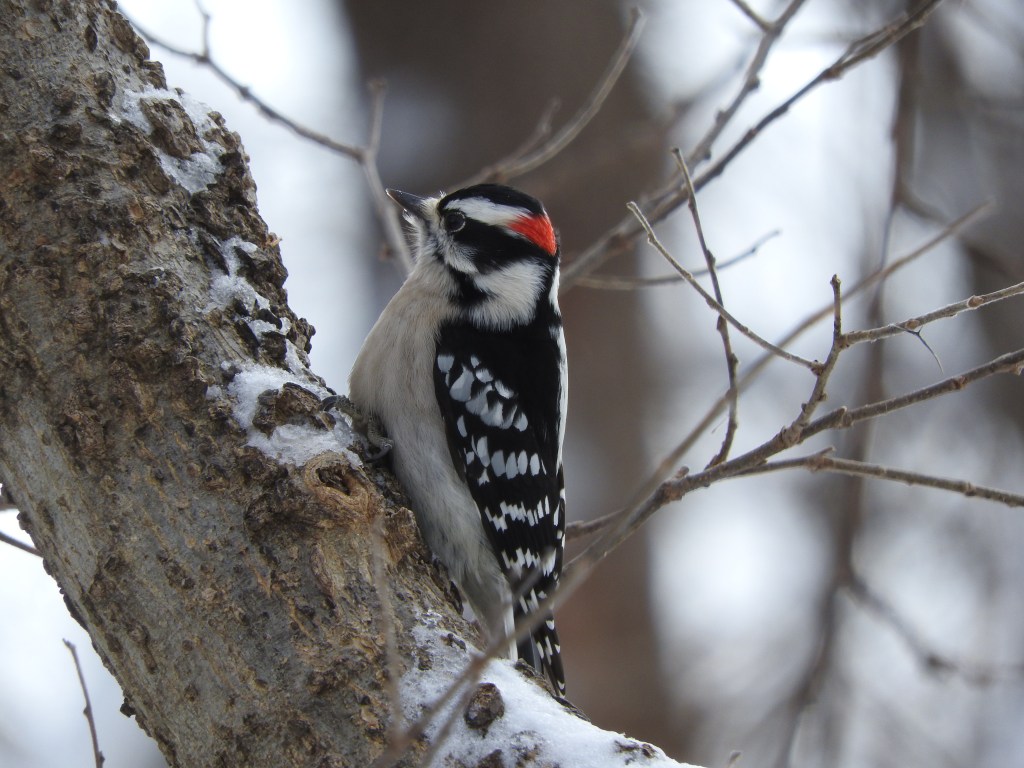
Every fall, millions of birds migrate south from the temperate forests of North America to winter in the warmer climes of Central and South America. Those that stay behind for the winter are faced with a difficult physiological dilemma – warm-blooded, their beating hearts are often just millimeters away from sub-zero temperatures.
Finding food for these small, overwintering birds is an balancing act between obtaining the amount of food needed to maintain their body temperature and avoiding predators while foraging for that food. Holding too much in the way of fat reserves can weigh birds down, leading to a reduction in agility and an increased risk of predation. Thus, these birds live on the margins, storing just enough fat to get them through a cold night before setting out to rebuild their energy stores the next day. Many studies show that these birds adjust their foraging effort daily in response to the previous night’s temperature and how much of their energy reserves they have burned to stay warm.
New research published by the Shizuka Lab shows that, for white-breasted nuthatches and downy woodpeckers, the foraging behavior of a bird’s close friends may be just as important, or even more important, than the previous night’s temperature in predicting an individual’s foraging activity.
Members of the Shizuka Lab suspected that social bonds may impact birds foraging behavior due to the prevalence of winter foraging flocks in temperate woodlands. In these forests, birds that may otherwise stick to strict territories in the summer often loosen their territory boundaries and come together with other individuals and species to forage in loose mixed-species foraging flocks. Membership in these flocks can reduce the risk of predation due to what is called the many-eyes effect – more eyes looking out for a predator leads to a higher likelihood of awareness when a predator is present. Less time searching for predators means that an individual can spend more time searching for food. This may be especially important in the winter when the lack of leaves on deciduous trees means reduced cover and increased risk of predation for foraging birds.
To determine the role of social relationships on winter foraging behavior, researchers banded white-breasted nuthatches and downy woodpeckers with PIT tags – similar to those used to identify lost dogs – and deploying RFID readers on eight birdfeeders spread throughout a Nebraska woodlot. Anytime a tagged bird used a bird feeder, the RFID reader would record which individual was at the feeder and the time it visited. With this data researchers were able to see how often a bird foraged at the feeders and who, if anyone, it was foraging with.
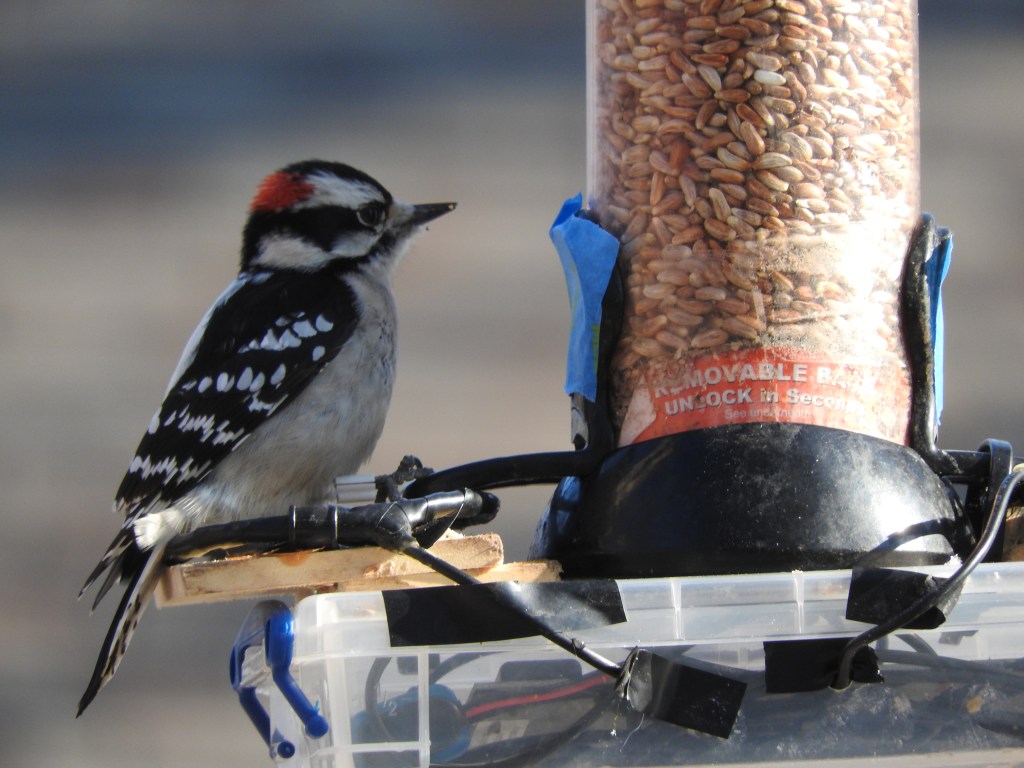
Results from this study confirm that an individual’s foraging behavior is tightly linked to its close social associates. However, because all birds in the study were subjected to the same overnight temperatures, it is difficult to disentangle the relative impacts of overnight temperatures and social behavior. It may be that birds that react similarly to overnight temperatures end up foraging with one another on a regular basis. Conversely, it may also be that a bird’s prefers certain social partners for other reasons, and it may make suboptimal energy decisions in order to forage with its preferred social partners.
The Shizuka Lab has recently received funding from the National Science Foundation to follow up on this study and begin to answer these further questions. In partnership with the Stager Lab at UMass-Amherst, they will subject birds to different overnight temperatures and observe how that impacts both a bird’s physiology and their social partners. Overtime will all the birds subjected to the same overnight temperatures begin to forage with one another, forming new social bonds? Or will birds maintain their social ties regardless of the temperature they or their favorite flock mates underwent the night before?
 Laura Vander Meiden